Calories Burned Boxing
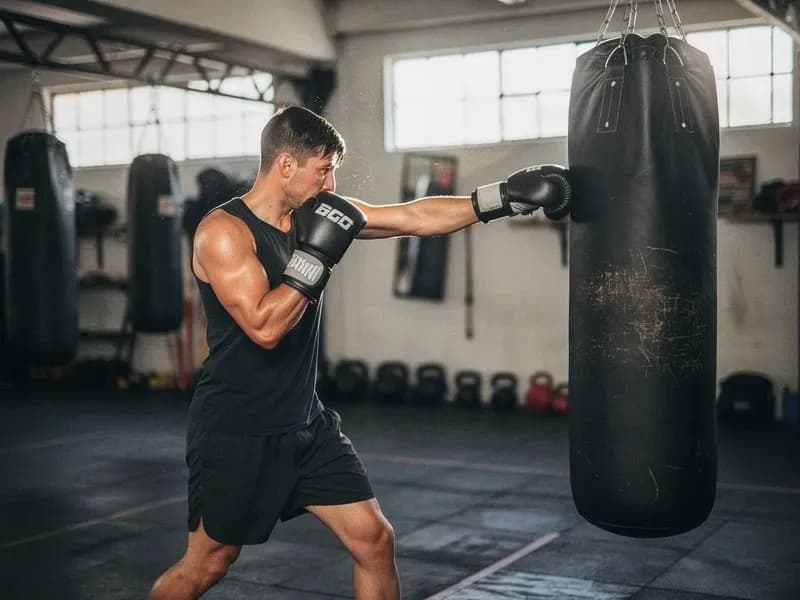
at 70 kg (154 lbs), 7.8 METs
Intensity
vigorous
Category
Sports
Muscles Worked
Equipment: Boxing gloves, Heavy bag or focus mitts, Hand wraps
Boxing is a high-intensity combat sport that delivers one of the best calorie-burning workouts available. Training with a punching bag or doing pad work burns approximately 7.8 METs. Boxing combines upper body power, footwork, and constant core engagement into a demanding full-body workout that builds both strength and endurance.
Boxing Calorie Calculator
30 min of boxing at 154 lbs (70 kg)
These estimates are for informational purposes only and should not replace professional medical advice. Actual calories burned vary based on individual factors including age, fitness level, body composition, and exercise intensity. Consult a healthcare provider before starting a new exercise program.
Track Your Boxing Burn
CaloBurner syncs with Apple Health to log your activity automatically.

Boxing Calories Burned by Weight & Duration
| Weight | 15 min | 30 min | 45 min | 60 min |
|---|---|---|---|---|
| 55 kg (121 lbs) | 113 cal | 225 cal | 338 cal | 450 cal |
| 70 kg (154 lbs) | 143 cal | 287 cal | 430 cal | 573 cal |
| 85 kg (187 lbs) | 174 cal | 348 cal | 522 cal | 696 cal |
| 100 kg (220 lbs) | 205 cal | 410 cal | 614 cal | 819 cal |
Calculated using the MET formula: calories = MET x weight (kg) x 3.5 / 200 x duration (min). MET value: 7.8 (Compendium of Physical Activities, Ainsworth et al. 2011).
Burn Off Your Meal with Boxing
Wendy's Baconator
900 cal
94 min of boxing
Panda Express Orange Chicken
510 cal
53 min of boxing
McDonald's Chicken McNuggets
410 cal
43 min of boxing
Five Guys Burger
984 cal
103 min of boxing
Estimates for a 70 kg (154 lb) person.
Boxing for Calorie Burning
Few workouts match the calories burned boxing delivers in a single session. Whether you are hitting a heavy bag, working mitts with a partner, or shadowboxing, the combination of rapid punching, defensive movement, and sustained footwork keeps your heart rate in the high-intensity zone. A 70 kg (154 lb) person burns approximately 573 calories per hour during a general boxing training session.
The reason boxing burns so many calories is the simultaneous engagement of upper and lower body muscles. Every punch starts from your legs and core, transfers through your torso, and finishes with your arms and shoulders. A typical boxing round includes 50-80 punches per minute during active combinations, each one requiring full-body coordination. The 1-minute rest periods between 3-minute rounds create a structured interval pattern that maximizes both aerobic and anaerobic conditioning.
Boxing also develops functional fitness that translates to everyday life. Improved hand-eye coordination, reaction time, and core stability are common benefits. Many people find boxing more engaging than traditional cardio because it requires focus and skill development, making the workout feel shorter and more enjoyable.
For weight loss, boxing is one of the most effective activities available. At 7.8 METs, it outperforms swimming (515 cal/hr), basketball (478 cal/hr), and cycling at moderate pace (551 cal/hr). Only a handful of activities like running (720 cal/hr), kickboxing (757 cal/hr), and jump rope (904 cal/hr) burn more. A single 45-minute session burns about 430 calories for a 70 kg person, roughly equivalent to a Chick-fil-A Chicken Sandwich at 420 calories. Three sessions per week creates a weekly burn of nearly 1,720 calories from boxing alone.
Beginners should start with shadowboxing and light bag work to build proper form before increasing intensity. The most common mistake new boxers make is throwing arm-only punches without rotating the hips and driving from the legs. This not only reduces punching power but also cuts calorie expenditure significantly, since the large muscles of the legs and core are doing less work. Focus on technique first: jab, cross, hook, and uppercut with full body rotation on every punch.
To progress and burn more over time, increase the number of rounds per session. Start with 6 rounds of 3 minutes (with 1-minute rest) and work up to 10 or 12 rounds. You can also shorten rest periods from 60 seconds to 30 seconds as your conditioning improves. Adding jump rope between rounds is a classic boxing conditioning method that pushes total session calorie burn even higher. As your skills develop, partner pad work and controlled sparring introduce reactive movement that elevates intensity beyond what bag work alone provides.
Tips to Maximize Calorie Burn During Boxing
- 1
Focus on throwing full combinations (3-5 punches) rather than single shots to keep your heart rate elevated and maximize calorie burn.
- 2
Stay light on your feet and keep moving between combinations. Active footwork adds lower body engagement and increases total calories burned by 15-20%.
- 3
Follow a round timer structure: 3 minutes of work followed by 1 minute of rest. Aim for 8-12 rounds per session.
- 4
Incorporate defensive movements like slips, rolls, and pivots to engage your core and legs, not just your arms.
- 5
Add shadowboxing rounds with light dumbbells (0.5-1 kg / 1-2 lb) to increase upper body resistance and calorie expenditure.
How Boxing Compares
Calories per hour based on a 70 kg (154 lb) person.
Frequently Asked Questions
How many calories does 30 minutes of boxing burn?
A 70 kg (154 lb) person burns approximately 287 calories in 30 minutes of boxing training. At 90 kg (198 lb), that increases to about 368 calories. This assumes general bag work and pad training. Sparring sessions can burn 10-15% more due to the added intensity of facing an opponent.
Is boxing a good workout for weight loss?
Boxing is one of the best workouts for weight loss. At 7.8 METs, it burns more calories per hour than basketball (6.5 METs), soccer (7.0 METs), or swimming (7.0 METs). A 70 kg (154 lb) person training three times per week for one hour burns roughly 1,719 calories from boxing alone, equivalent to about 0.22 kg (0.5 lb) of fat loss per week.
Do you need a partner to do a boxing workout?
No. Heavy bag work, shadowboxing, and boxing fitness classes are all effective solo workouts. Shadowboxing alone burns about 5.5 METs and requires no equipment at all. Heavy bag training at 7.8 METs provides more resistance and higher calorie burn. Partner pad work adds variety but is not required for a great workout.
How does boxing compare to running for calorie burn?
Boxing at 7.8 METs burns slightly less than running at 9.7 km/h (6 mph) at 9.8 METs. For a 70 kg (154 lb) person, boxing burns about 573 calories per hour versus 720 for running. However, boxing engages more upper body muscles and many people find it more sustainable over 45-60 minute sessions due to the built-in rest periods between rounds.
What muscles does boxing work the most?
Boxing primarily works your shoulders, which fatigue fastest during extended sessions. Your core muscles (obliques, rectus abdominis, transverse abdominis) are engaged in every punch for power transfer and rotation. Your legs, particularly quadriceps and calves, power your footwork and generate punching force from the ground up.
Related Activities
Track Your Boxing Calories
CaloBurner syncs with Apple Health to count your steps and estimate calories burned throughout the day. Combine your boxing burn data with AI-powered meal tracking for a complete picture.
Calculate your daily calorie target · Browse restaurant calories
MET values from the Compendium of Physical Activities, Ainsworth et al. 2011. Calorie estimates are approximations and vary based on individual factors including fitness level, body composition, and exercise intensity. Written by the CaloBurner team.