Calories Burned Soccer
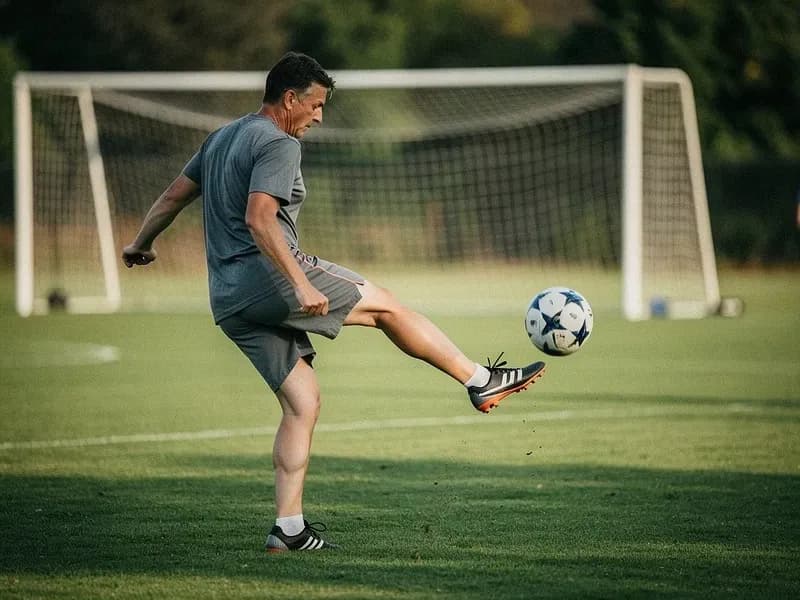
at 70 kg (154 lbs), 7 METs
Intensity
vigorous
Category
Sports
Muscles Worked
Equipment: Soccer ball, Cleats
Soccer is a high-energy team sport that combines sustained running with explosive sprints, making it one of the top calorie-burning activities. A casual game of soccer burns approximately 7.0 METs. The constant movement across a full pitch keeps your heart rate elevated for the entire match.
Soccer Calorie Calculator
30 min of soccer at 154 lbs (70 kg)
These estimates are for informational purposes only and should not replace professional medical advice. Actual calories burned vary based on individual factors including age, fitness level, body composition, and exercise intensity. Consult a healthcare provider before starting a new exercise program.
Track Your Soccer Burn
CaloBurner syncs with Apple Health to log your activity automatically.

Soccer Calories Burned by Weight & Duration
| Weight | 15 min | 30 min | 45 min | 60 min |
|---|---|---|---|---|
| 55 kg (121 lbs) | 101 cal | 202 cal | 303 cal | 404 cal |
| 70 kg (154 lbs) | 129 cal | 257 cal | 386 cal | 515 cal |
| 85 kg (187 lbs) | 156 cal | 312 cal | 469 cal | 625 cal |
| 100 kg (220 lbs) | 184 cal | 368 cal | 551 cal | 735 cal |
Calculated using the MET formula: calories = MET x weight (kg) x 3.5 / 200 x duration (min). MET value: 7 (Compendium of Physical Activities, Ainsworth et al. 2011).
Burn Off Your Meal with Soccer
Popeyes Chicken Sandwich
700 cal
82 min of soccer
Taco Bell Crunchwrap Supreme
530 cal
62 min of soccer
In-N-Out Cheeseburger
430 cal
50 min of soccer
McDonald's Big Mac
580 cal
68 min of soccer
Estimates for a 70 kg (154 lb) person.
Soccer for Calorie Burning
Among team sports, calories burned soccer are some of the highest, with players covering 8-12 km (5-7.5 miles) during a typical 90-minute match. The combination of jogging, sprinting, and directional changes creates an interval training effect that is highly effective for burning calories. A 70 kg (154 lb) player burns approximately 515 calories per hour of casual play.
The calorie burn in soccer varies significantly based on position and playing style. Midfielders and forwards typically burn 10-20% more calories than goalkeepers or defenders who stay in a fixed zone. Playing on a full-size pitch rather than a smaller indoor court also increases total distance covered and overall energy expenditure.
Soccer also provides excellent lower body conditioning, strengthening your quadriceps, hamstrings, calves, and hip flexors through repeated kicking, sprinting, and pivoting. The sport improves agility, balance, and coordination while delivering a workout that feels more like play than exercise. Even recreational leagues and pickup games provide substantial calorie burn, making soccer an accessible option for weight management.
At 515 calories per hour, soccer burns the same as swimming and skating (both 515 cal/hr) and outpaces basketball (478 cal/hr), hiking (441 cal/hr), and dancing (404 cal/hr). A full 90-minute match burns roughly 772 calories for a 70 kg person. That is close to the calorie content of a Popeyes Chicken Sandwich at 700 calories. The interval nature of soccer (short sprints mixed with jogging and walking) also triggers excess post-exercise oxygen consumption (EPOC), meaning your body continues burning calories at an elevated rate for hours after you finish playing.
Beginners looking to use soccer for fitness do not need to join a competitive league. Pickup games at local parks, recreational adult leagues, and even solo drills against a wall provide a solid workout. Start with shorter games (30 to 45 minutes) and focus on staying active throughout rather than standing and waiting for the ball. A common mistake in recreational soccer is clustering around the ball. Spreading out across the field forces you to run more, which directly increases your calorie burn.
To progress and maximize calories burned, focus on improving your cardiovascular base so you can sustain a higher effort level throughout a full match. Running 2 to 3 times per week outside of soccer games builds the aerobic capacity needed to cover more ground during play. On the pitch, make a conscious effort to sprint during transitions between offense and defense rather than jogging. These high-intensity bursts are where the majority of your extra calorie burn comes from, and they mirror the interval training approach that research consistently links to greater fat loss.
Tips to Maximize Calorie Burn During Soccer
- 1
Play on a full-size outdoor pitch to maximize running distance and calorie burn compared to smaller indoor fields.
- 2
Stay involved in transition play by sprinting back on defense and pushing forward on attack to maintain a high heart rate.
- 3
Play in midfield or forward positions to cover more ground. Midfielders typically run 10-12 km (6-7.5 miles) per match.
- 4
Incorporate interval sprints during warmup to prepare your body for the stop-start nature of the game.
- 5
Play full 90-minute matches or aim for at least 45 minutes of continuous play to maximize total calorie expenditure.
How Soccer Compares
Calories per hour based on a 70 kg (154 lb) person.
Frequently Asked Questions
How many calories does a 90-minute soccer game burn?
A 70 kg (154 lb) player burns approximately 772 calories during a full 90-minute soccer game. A heavier player at 90 kg (198 lb) burns around 992 calories. These estimates are for casual recreational play. Competitive matches with more sprinting can burn 10-20% more.
How far do soccer players run in a game?
Recreational players typically cover 6-8 km (3.7-5 miles) per game, while competitive players run 10-12 km (6.2-7.5 miles). Midfielders run the most, often exceeding 12 km (7.5 miles). This sustained running is a major reason why soccer is such an effective calorie-burning sport.
Is soccer better than running for weight loss?
Soccer at 7.0 METs burns slightly fewer calories per minute than running at 9.7 km/h (6 mph) which is 9.8 METs. However, soccer games last 60-90 minutes and the competitive nature makes them more sustainable long-term. A 70 kg (154 lb) person burns about 515 calories per hour of soccer versus 720 calories per hour of running.
Does playing soccer build muscle?
Soccer builds significant lower body muscle, particularly in the quadriceps, hamstrings, calves, and glutes. Repeated sprinting, kicking, and directional changes provide resistance training for your legs. The sport also strengthens your core through balance and stability demands. It is not a substitute for dedicated strength training, but it provides functional lower body conditioning.
How many calories does 30 minutes of soccer burn?
A 70 kg (154 lb) person burns approximately 257 calories in 30 minutes of soccer. At 90 kg (198 lb), that increases to about 331 calories. Actual burn depends on your effort level. Continuous play with sprinting burns more than standing around waiting for the ball.
Related Activities
Track Your Soccer Calories
CaloBurner syncs with Apple Health to count your steps and estimate calories burned throughout the day. Combine your soccer burn data with AI-powered meal tracking for a complete picture.
Calculate your daily calorie target · Browse restaurant calories
MET values from the Compendium of Physical Activities, Ainsworth et al. 2011. Calorie estimates are approximations and vary based on individual factors including fitness level, body composition, and exercise intensity. Written by the CaloBurner team.