Calories Burned Snowboarding
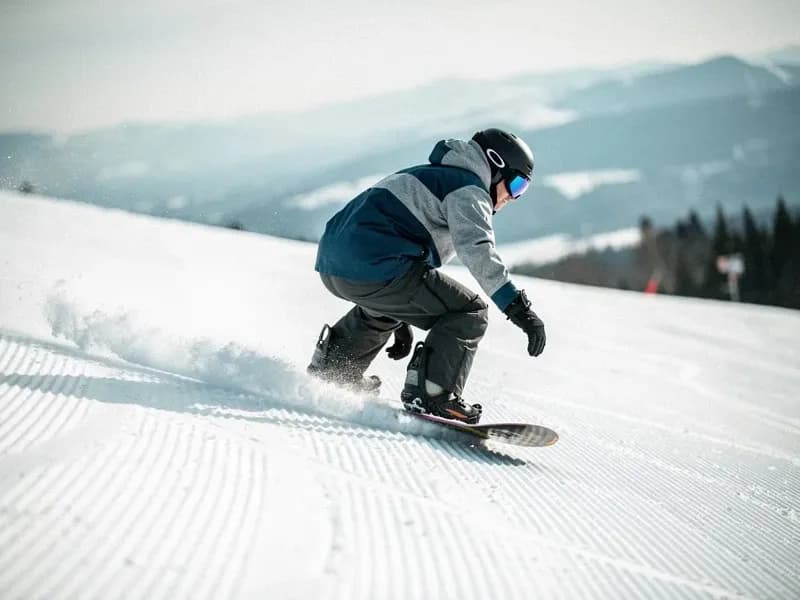
at 70 kg (154 lbs), 5.3 METs
Intensity
moderate
Category
Sports
Muscles Worked
Equipment: Snowboard, Snowboard boots, Helmet, Goggles
Snowboarding is a moderate-intensity winter sport that challenges your balance, core stability, and lower-body endurance while carving down slopes. At 5.3 METs, a 70 kg (154 lb) person burns approximately 390 calories per hour of general snowboarding, making it an effective calorie-burning activity during the winter months.
Snowboarding Calorie Calculator
30 min of snowboarding at 154 lbs (70 kg)
These estimates are for informational purposes only and should not replace professional medical advice. Actual calories burned vary based on individual factors including age, fitness level, body composition, and exercise intensity. Consult a healthcare provider before starting a new exercise program.
Track Your Snowboarding Burn
CaloBurner syncs with Apple Health to log your activity automatically.

Snowboarding Calories Burned by Weight & Duration
| Weight | 15 min | 30 min | 45 min | 60 min |
|---|---|---|---|---|
| 55 kg (121 lbs) | 77 cal | 153 cal | 230 cal | 306 cal |
| 70 kg (154 lbs) | 97 cal | 195 cal | 292 cal | 390 cal |
| 85 kg (187 lbs) | 118 cal | 237 cal | 355 cal | 473 cal |
| 100 kg (220 lbs) | 139 cal | 278 cal | 417 cal | 557 cal |
Calculated using the MET formula: calories = MET x weight (kg) x 3.5 / 200 x duration (min). MET value: 5.3 (Compendium of Physical Activities, Ainsworth et al. 2011).
Burn Off Your Meal with Snowboarding
McDonald's Big Mac
580 cal
89 min of snowboarding
Popeyes Chicken Sandwich
700 cal
108 min of snowboarding
McDonald's Fries
320 cal
49 min of snowboarding
McDonald's Quarter Pounder
520 cal
80 min of snowboarding
Estimates for a 70 kg (154 lb) person.
Snowboarding for Calorie Burning
The calories burned snowboarding come from sustained lower-body engagement, core stabilization, and the cardiovascular demand of riding at altitude. At 5.3 METs, general snowboarding burns more calories than many indoor exercises while feeling like pure recreation.
A 70 kg (154 lb) person burns approximately 390 calories per hour of active snowboarding. A typical full day on the mountain (4-5 hours of actual riding time, excluding lift rides) can burn 1,560-1,950 calories. The cold weather environment also increases calorie expenditure slightly, as your body works harder to maintain core temperature.
Snowboarding places significant demands on your quadriceps, hamstrings, and core muscles. The constant need to balance on an edge while absorbing terrain changes builds functional leg strength and deep core stability. The sport also develops ankle mobility and proprioception. Regular snowboarders often notice improved balance and leg endurance that carries over to other physical activities.
For weight loss, snowboarding is most effective when viewed as part of a full-day calorie burn rather than a per-hour metric. While 390 calories per hour is lower than skiing (515 cal/hr), running (720 cal/hr), or swimming (515 cal/hr), the fact that snowboarding typically involves 4 to 5 hours of riding in a single day puts the total burn on par with or above most gym sessions. A 70 kg person who rides for 4 hours burns roughly 1,560 calories, which is the equivalent of about five McDonald's cheeseburgers at 300 calories each.
Beginners should expect to burn more calories than experienced riders during their first few sessions. Falling and getting back up repeatedly is physically demanding, and the lack of efficient technique means your muscles work harder on every turn. As you improve, you can maintain a high calorie burn by choosing steeper terrain, riding powder (which requires more leg effort than groomed runs), and reducing your rest time between runs. Aggressive carving with deep edge angles engages your legs and core far more than skidding your turns.
A common mistake that lowers calorie burn is spending too much time on the chairlift or in the lodge between runs. To maximize your workout, choose shorter runs with quick lift access. Another mistake is riding with a stiff, upright posture. Staying low with bent knees keeps your quadriceps and glutes under constant tension, which increases both muscle engagement and energy expenditure. Off-season conditioning with squats, lunges, and single-leg balance work prepares your body to ride longer and harder, directly increasing your total calorie burn on mountain days.
Tips to Maximize Calorie Burn During Snowboarding
- 1
Ride aggressively with deep carving turns instead of skidding to engage your legs and core more intensely.
- 2
Take fewer breaks between runs to keep your heart rate elevated and maximize your calorie burn per hour on the mountain.
- 3
Ride in varied terrain (groomed runs, moguls, powder) to challenge different muscle groups and avoid plateaus.
- 4
Warm up with 5-10 minutes of dynamic stretching and bodyweight squats before your first run to prevent injury.
- 5
Supplement snowboarding with off-season leg exercises (squats, lunges, wall sits) to improve your riding endurance and calorie burn.
How Snowboarding Compares
Calories per hour based on a 70 kg (154 lb) person.
Frequently Asked Questions
How many calories does a full day of snowboarding burn?
A full day of snowboarding with 4-5 hours of active riding time burns approximately 1,560-1,950 calories for a 70 kg (154 lb) person. A heavier person at 90 kg (198 lb) can burn 2,000-2,500 calories. Note that lift time and breaks reduce the active riding hours, so a 7-hour day on the mountain typically includes 4-5 hours of actual snowboarding.
Does snowboarding burn more calories than skiing?
Skiing at 7.0 METs burns approximately 515 calories per hour for a 70 kg (154 lb) person, compared to 390 calories for snowboarding at 5.3 METs. Skiing burns more because it uses both legs independently and involves more continuous pole work. However, snowboarding demands more from the core for balance, and beginners often burn more calories due to frequent falling and recovery.
Does the cold weather increase calorie burn while snowboarding?
Yes, mildly. Your body expends additional energy maintaining its core temperature of 37 degrees C (98.6 degrees F) in cold conditions. Research suggests this can increase calorie burn by 5-15% depending on temperature, wind chill, and clothing. For a 70 kg (154 lb) person snowboarding in cold conditions, this could add 20-60 extra calories per hour beyond the base 390 calories.
How long do I need to snowboard to burn 500 calories?
A 70 kg (154 lb) person needs approximately 1 hour and 17 minutes of active snowboarding to burn 500 calories at the standard 5.3 MET rate. A heavier person at 90 kg (198 lb) would reach 500 calories in about 60 minutes. Aggressive riding with deep carving can reduce the time needed by increasing the effective intensity.
Is snowboarding a full-body workout?
Snowboarding is primarily a lower-body and core workout. Your quadriceps, hamstrings, calves, and glutes bear the main load during turns and terrain absorption. Your core muscles are constantly engaged for balance and edge control. The upper body is less involved than in skiing (which uses poles), though your arms and shoulders help with balance and getting up after falls.
Related Activities
Track Your Snowboarding Calories
CaloBurner syncs with Apple Health to count your steps and estimate calories burned throughout the day. Combine your snowboarding burn data with AI-powered meal tracking for a complete picture.
Calculate your daily calorie target · Browse restaurant calories
MET values from the Compendium of Physical Activities, Ainsworth et al. 2011. Calorie estimates are approximations and vary based on individual factors including fitness level, body composition, and exercise intensity. Written by the CaloBurner team.