Calories Burned Rowing
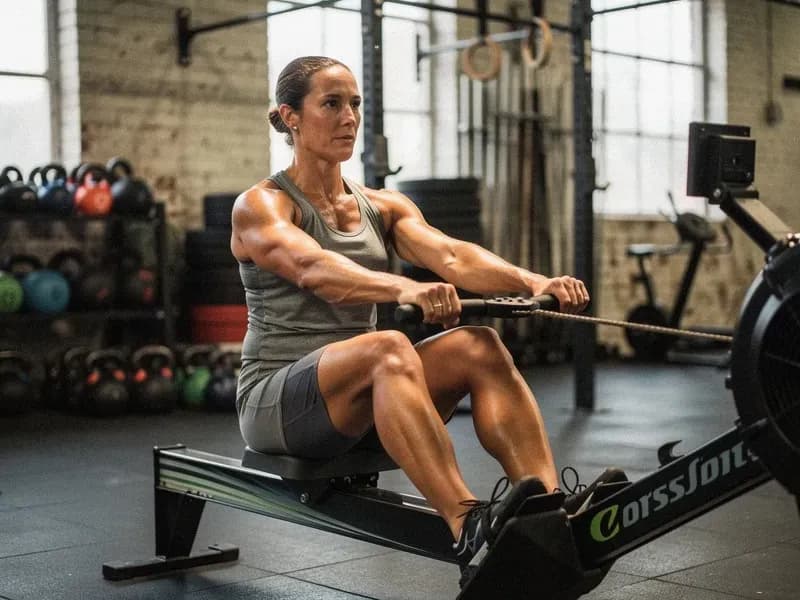
at 70 kg (154 lbs), 7 METs
Intensity
vigorous
Category
Cardio
Muscles Worked
Equipment: Rowing Machine
Rowing is a full-body cardio exercise that engages 86% of your muscles in every stroke. Moderate-effort stationary rowing burns approximately 7.0 METs. A 70 kg (154 lb) person can burn about 515 calories per hour on a rowing machine, combining cardiovascular conditioning with significant upper-body and core strength development in a single low-impact movement.
Rowing Calorie Calculator
30 min of rowing at 154 lbs (70 kg)
These estimates are for informational purposes only and should not replace professional medical advice. Actual calories burned vary based on individual factors including age, fitness level, body composition, and exercise intensity. Consult a healthcare provider before starting a new exercise program.
Track Your Rowing Burn
CaloBurner syncs with Apple Health to log your activity automatically.

Rowing Calories Burned by Weight & Duration
| Weight | 15 min | 30 min | 45 min | 60 min |
|---|---|---|---|---|
| 55 kg (121 lbs) | 101 cal | 202 cal | 303 cal | 404 cal |
| 70 kg (154 lbs) | 129 cal | 257 cal | 386 cal | 515 cal |
| 85 kg (187 lbs) | 156 cal | 312 cal | 469 cal | 625 cal |
| 100 kg (220 lbs) | 184 cal | 368 cal | 551 cal | 735 cal |
Calculated using the MET formula: calories = MET x weight (kg) x 3.5 / 200 x duration (min). MET value: 7 (Compendium of Physical Activities, Ainsworth et al. 2011).
Burn Off Your Meal with Rowing
McDonald's Big Mac
580 cal
68 min of rowing
Chipotle Chicken Burrito
1110 cal
129 min of rowing
McDonald's Quarter Pounder
520 cal
61 min of rowing
Estimates for a 70 kg (154 lb) person.
Rowing for Calorie Burning
Among cardio exercises, calories burned rowing stand out because every stroke works both your upper and lower body. The drive phase engages your legs, back, and core, while the recovery phase works your arms, shoulders, and lats. At 7.0 METs, moderate-effort rowing burns approximately 515 calories per hour for a 70 kg (154 lb) person.
Calorie burn on the rower depends on stroke rate and resistance. Rowing at 24-28 strokes per minute at moderate resistance is the sweet spot for sustained calorie burn. Increasing to vigorous effort (30+ strokes per minute with higher resistance) can push the burn to 650-700 calories per hour. A 85 kg (187 lb) person burns roughly 625 calories per hour at moderate effort, while a 55 kg (121 lb) person burns about 404 calories.
Rowing is also one of the most efficient exercises for time-constrained workouts. A 20-minute rowing interval session can burn 170-200 calories for a 70 kg person while building functional strength across your entire posterior chain. The low-impact nature of rowing makes it suitable for daily training without the joint stress of running. Rowing for 20 to 30 minutes works well as a warm-up before strength training or as a standalone cardio session.
For weight loss, rowing offers an excellent balance of calorie burn and sustainability. At 515 calories per hour, it matches swimming (515 cal/hr) and outpaces weight lifting (441 cal/hr), elliptical training (368 cal/hr), and hiking (441 cal/hr). A 30-minute rowing session for a 70 kg person burns about 258 calories, roughly the same as a McDonald's Cheeseburger at 300 calories. Because rowing is low-impact, you can train 5-6 days per week without the joint strain that daily running causes, which adds up to significant weekly calorie expenditure.
Beginners often make two key mistakes on the rower. The first is pulling with the arms too early in the stroke. The drive should start with your legs, then your back opens, and finally your arms pull to the chest. Reversing this sequence reduces power output and calorie burn while putting unnecessary stress on your lower back. The second common mistake is setting the damper too high. A setting of 8-10 feels harder but does not necessarily burn more calories. It slows your stroke rate and fatigues your muscles prematurely. A damper setting of 3-5 allows a faster, more sustainable pace that maximizes total work per session.
To progress over time, focus on improving your split time (the time it takes to row 500 meters) rather than just rowing longer. A faster split at the same stroke rate means you are generating more power per stroke, which directly increases calorie burn. Start with 2,000-meter pieces and work toward consistent pacing. Once you can hold a steady split for 20 minutes, begin adding interval work: alternate between 1-minute hard efforts and 1-minute easy recovery for 20-30 minutes. This interval format can push your average calorie burn closer to 600-700 calories per hour while building both aerobic and anaerobic fitness.
Tips to Maximize Calorie Burn During Rowing
- 1
Maintain proper form: drive with your legs first, then lean back slightly, and pull the handle to your lower chest.
- 2
Keep your stroke rate between 24-28 strokes per minute for sustained moderate effort. Going faster often reduces power per stroke.
- 3
Set the damper on the rowing machine to 3-5 for most workouts. Higher settings do not always mean more calories burned.
- 4
Try a 500-meter interval workout: row 500 meters hard, rest 1 minute, and repeat 6-8 times for maximum calorie burn.
- 5
Focus on the drive-to-recovery ratio. Aim for a 1:2 ratio, spending twice as long on the recovery as the drive phase.
How Rowing Compares
Calories per hour based on a 70 kg (154 lb) person.
Frequently Asked Questions
How many calories does rowing burn per hour?
A 70 kg (154 lb) person rowing at moderate effort burns approximately 515 calories per hour. Vigorous rowing can burn 650-700 calories per hour. A 90 kg (198 lb) person burns about 662 calories per hour at moderate effort. The rowing machine is one of the most efficient calorie-burning machines in the gym because it engages both your upper and lower body.
Is rowing good for weight loss?
Yes, rowing is excellent for weight loss. It burns 515 calories per hour at moderate effort for a 70 kg (154 lb) person and engages 86% of your muscles, which helps build lean mass and increase your resting metabolic rate. Rowing 30 minutes, 4 times per week burns roughly 1,030 calories per week, supporting about 0.13 kg (0.3 lb) of fat loss weekly from exercise alone.
Does rowing build muscle?
Yes, rowing builds functional muscle, particularly in your back, shoulders, biceps, and legs. Each stroke involves a powerful leg drive followed by an upper-body pull, similar to a deadlift-row combination. A 70 kg (154 lb) person performing 25 strokes per minute for 30 minutes completes 750 full-body repetitions. For maximum muscle development, combine rowing with dedicated weight lifting sessions.
How long should I row to burn 500 calories?
A 70 kg (154 lb) person needs approximately 58 minutes of moderate rowing to burn 500 calories. At vigorous effort, this drops to about 45-46 minutes. A heavier person at 90 kg (198 lb) reaches 500 calories in roughly 45 minutes at moderate effort. For a more intense approach, 20-minute interval sessions can burn 250-300 calories and be repeated with a break between.
Is rowing better than cycling for calorie burn?
Rowing and cycling at moderate effort burn very similar calories. A 70 kg (154 lb) person burns about 515 calories per hour rowing versus 551 cycling. Cycling has a slight edge per hour, but rowing engages significantly more upper-body muscles. The best choice depends on your goals: rowing for full-body conditioning, cycling for lower-body focus and longer duration sessions.
Related Activities
Track Your Rowing Calories
CaloBurner syncs with Apple Health to count your steps and estimate calories burned throughout the day. Combine your rowing burn data with AI-powered meal tracking for a complete picture.
Calculate your daily calorie target · Browse restaurant calories
MET values from the Compendium of Physical Activities, Ainsworth et al. 2011. Calorie estimates are approximations and vary based on individual factors including fitness level, body composition, and exercise intensity. Written by the CaloBurner team.