Calories Burned Badminton
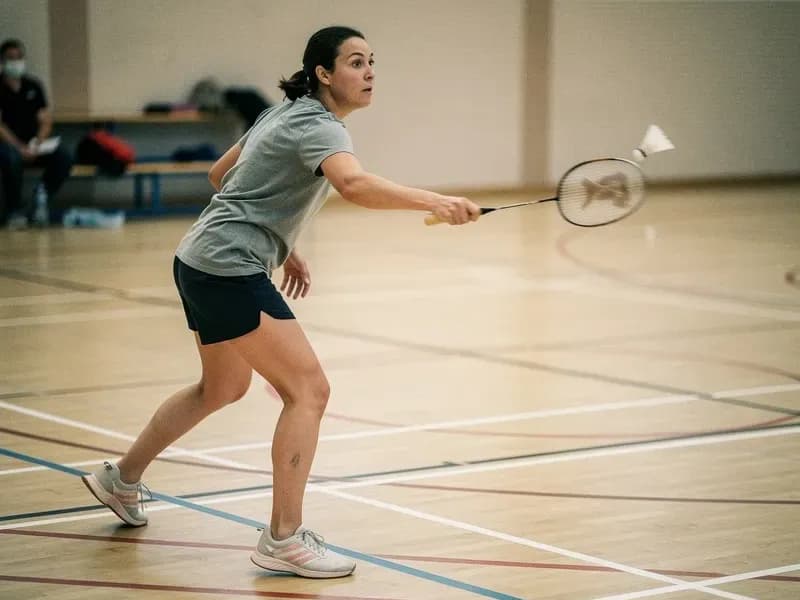
at 70 kg (154 lbs), 5.5 METs
Intensity
moderate
Category
Sports
Muscles Worked
Equipment: Badminton racquet, Shuttlecock, Net
Badminton is a moderate-intensity racquet sport that combines quick footwork, explosive lunges, and overhead swings to deliver a strong calorie burn. At 5.5 METs, a 70 kg (154 lb) person burns approximately 404 calories per hour of general badminton play, making it more demanding than many people expect.
Badminton Calorie Calculator
30 min of badminton at 154 lbs (70 kg)
These estimates are for informational purposes only and should not replace professional medical advice. Actual calories burned vary based on individual factors including age, fitness level, body composition, and exercise intensity. Consult a healthcare provider before starting a new exercise program.
Track Your Badminton Burn
CaloBurner syncs with Apple Health to log your activity automatically.

Badminton Calories Burned by Weight & Duration
| Weight | 15 min | 30 min | 45 min | 60 min |
|---|---|---|---|---|
| 55 kg (121 lbs) | 79 cal | 159 cal | 238 cal | 318 cal |
| 70 kg (154 lbs) | 101 cal | 202 cal | 303 cal | 404 cal |
| 85 kg (187 lbs) | 123 cal | 245 cal | 368 cal | 491 cal |
| 100 kg (220 lbs) | 144 cal | 289 cal | 433 cal | 578 cal |
Calculated using the MET formula: calories = MET x weight (kg) x 3.5 / 200 x duration (min). MET value: 5.5 (Compendium of Physical Activities, Ainsworth et al. 2011).
Burn Off Your Meal with Badminton
McDonald's Big Mac
580 cal
86 min of badminton
Popeyes Chicken Sandwich
700 cal
104 min of badminton
McDonald's Fries
320 cal
47 min of badminton
Taco Bell Chicken Quesadilla
490 cal
73 min of badminton
Estimates for a 70 kg (154 lb) person.
Badminton for Calorie Burning
Most people underestimate the calories burned badminton requires, but it is actually one of the most demanding racquet sports. The fast-paced rallies require constant lateral movement, lunging, jumping, and rapid changes of direction. At 5.5 METs, general badminton play burns significantly more calories than casual sports like table tennis (4.0 METs, 294 cal/hr) or volleyball (4.0 METs, 294 cal/hr).
A 70 kg (154 lb) person burns approximately 404 calories per hour playing badminton. Competitive singles matches push the intensity even higher, with MET values reaching 7.0 or more due to the larger court coverage and longer rallies. The sport demands both aerobic endurance for sustained play and anaerobic power for explosive shots and overhead smashes.
Badminton is particularly effective for developing agility, hand-eye coordination, and lower-body explosiveness. The constant lunging motion builds quadriceps and glute strength, while overhead shots engage the shoulders and core. It is an accessible and social way to burn calories, since it can be played recreationally with minimal equipment or competitively for maximum intensity.
For weight loss, badminton fits well into a calorie deficit plan. Playing three times per week for one hour burns roughly 1,212 calories for a 70 kg person, which is equivalent to about 0.15 kg (0.35 lb) of fat loss per week from exercise alone. Compared to activities like walking (257 cal/hr) or yoga (221 cal/hr), badminton nearly doubles the calorie burn while feeling more like play than exercise. A 45-minute session burns around 303 calories, roughly equal to a medium order of McDonald's Fries at 320 calories.
Beginners can start with casual rallies focused on keeping the shuttlecock in play rather than hitting winners. This builds the footwork and timing needed for longer, more intense sessions. One common mistake is standing flat-footed between shots, which reduces both movement efficiency and calorie burn. Staying on the balls of your feet and returning to center court after each shot forces continuous lower-body engagement.
To progress over time, move from doubles to singles play. Singles requires covering the full court alone, increasing your distance traveled per rally by 40-60%. You can also extend session length gradually, working from 30 minutes up to 60 or 90 minutes as your endurance improves. Adding drills like multi-shuttle footwork exercises between games will push your heart rate higher and build the stamina needed for longer competitive rallies.
Tips to Maximize Calorie Burn During Badminton
- 1
Stay light on your feet and return to the center of the court after each shot to maximize movement and calorie burn.
- 2
Play singles instead of doubles to cover more court area and increase your calorie expenditure by 25-35%.
- 3
Focus on deep lunges when reaching for drop shots to engage your quadriceps and glutes more intensely.
- 4
Practice overhead smashes and clears to engage your shoulders, core, and triceps with each shot.
- 5
Play for at least 45 continuous minutes to accumulate over 300 calories burned for a 70 kg (154 lb) person.
How Badminton Compares
Calories per hour based on a 70 kg (154 lb) person.
Frequently Asked Questions
How many calories does 1 hour of badminton burn?
A 70 kg (154 lb) person burns approximately 404 calories per hour playing general badminton. Competitive singles can burn 515-550 calories per hour due to increased intensity and court coverage. A lighter person at 55 kg (121 lb) burns about 317 calories, while a heavier person at 90 kg (198 lb) burns around 519 calories per hour.
Is badminton a good workout?
Yes. At 5.5 METs, badminton is classified as a moderate-to-vigorous activity. It builds cardiovascular fitness, agility, and lower-body strength simultaneously. A 70 kg (154 lb) person playing badminton for 30 minutes burns about 202 calories, comparable to 30 minutes of moderate cycling. The sport also improves hand-eye coordination and reaction time.
Does badminton burn more calories than tennis?
Tennis at 7.3 METs burns approximately 536 calories per hour for a 70 kg (154 lb) person, which is about 33% more than general badminton at 5.5 METs (404 calories per hour). However, competitive badminton (7.0+ METs) approaches tennis-level calorie burn. Tennis involves heavier racquet swings and a larger court, which accounts for the higher average intensity.
How does singles badminton compare to doubles for calorie burn?
Singles badminton burns approximately 25-35% more calories than doubles because you cover the entire court alone. For a 70 kg (154 lb) person, singles burns roughly 500-540 calories per hour compared to 350-404 calories for doubles. In doubles, the shared court coverage means less distance traveled and fewer lunges per player.
What muscles does badminton work the most?
Badminton primarily targets the quadriceps and calves through constant lunging and footwork. The shoulders, forearms, and wrists are heavily engaged during overhead smashes and clears. Your core works continuously for balance and rotational power during shots. The glutes are activated during deep lunges, which are frequent in competitive play.
Related Activities
Track Your Badminton Calories
CaloBurner syncs with Apple Health to count your steps and estimate calories burned throughout the day. Combine your badminton burn data with AI-powered meal tracking for a complete picture.
Calculate your daily calorie target · Browse restaurant calories
MET values from the Compendium of Physical Activities, Ainsworth et al. 2011. Calorie estimates are approximations and vary based on individual factors including fitness level, body composition, and exercise intensity. Written by the CaloBurner team.